Super NES audio hum: the audio amp decoupling and the S-DSP
Symptom A hum under all audio that is worse on loud passages, plus a faint whine that changes pitch with the music.
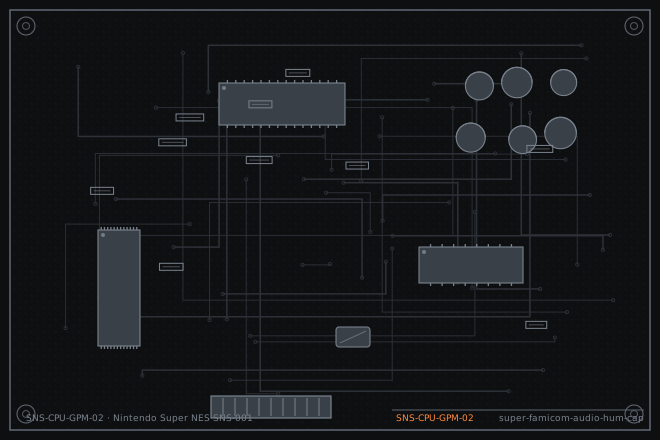
The Super NES audio path is short: the S-DSP inside the audio subsystem outputs a low-level signal that goes through a small amplifier and straight to the multi-out. Hum in that path is almost always the amplifier's supply decoupling rather than the DSP, and the whole repair is four capacitors.
Telling supply hum from DSP noise
Supply hum is constant and does not change with the game. DSP noise changes with what the audio hardware is doing, and on a Super NES a DSP problem usually produces silence or distorted sound rather than a hum.
A faint whine that changes pitch with the music is a different thing again: it is usually the amplifier picking up switching noise from the cartridge or from the video circuit through a shared ground. That is a grounding issue, not a capacitor issue, and replacing capacitors will not fix it.
Measuring what the amp is being fed
Measure the amplifier supply pin in AC mode with a game running. A clean supply reads under 10 mV AC. Anything above 30 mV AC will be audible, and it is coming from the rail rather than from the DSP.
Then short the amplifier input to ground with a clip lead and listen. If the hum disappears, it is coming in through the input and the fault is upstream. If the hum stays, it is coming through the supply and the decoupling capacitors are the problem.
- Run a game with a quiet passage and turn the volume up to identify whether the hum is constant.
- Measure the amplifier supply pin in AC volts with the game running. Record the value.
- Short the amplifier input to ground and listen. Hum disappears means an upstream fault; hum stays means a supply fault.
- Check the amplifier decoupling capacitors for bulging, leakage or a domed top.
- Measure each decoupling capacitor with an ESR meter. Anything more than twice its marked ESR is due for replacement.
Replacing the decoupling set
Replace the amplifier supply decoupling capacitors and the input coupling capacitor as a set. They are all the same age and they all fail within a few years of each other, so replacing one and leaving three is a repair that comes back.
Use 105 °C parts and match the capacitance exactly. On a Super NES the audio amplifier runs from the same 5 V rail as the logic, so the decoupling has to handle digital switching noise as well as supply ripple. A larger capacitor is not automatically better here; too much capacitance on a small regulator output can cause it to become unstable.
- Note the orientation and value of each capacitor before removing it.
- Replace the supply decoupling capacitors first and re-test.
- If hum persists, replace the input coupling capacitor as well.
- Measure the supply in AC mode again after the repair. Target is under 10 mV AC.
- Reassemble and test with a game that has both quiet and loud passages, since a repair that only works at low volume is not finished.
- If the hum is still present, check the shared ground between the audio and video sections rather than replacing more capacitors.
Fault tree branches
where this symptom also leadsIf: The hum is present on a different console with the same cable
The cable or the display is the problem, not the console.
Mega Drive Model 1 audio buzz: the ground return through the AV cableIf: There is no audio at all rather than hum
Check the amplifier supply and the DSP output, which is a different fault.
Super NES with no picture: replacing a failed PPUIf: The hum gets worse as the console warms up
The main rail filter capacitor is drying out. Replace it as well.
Famicom audio hum: the 5 V rail is not as clean as the meter says