Famicom audio hum: the 5 V rail is not as clean as the meter says
Symptom A steady low hum under all audio, hum gets louder with the volume, and the picture shows faint diagonal bars that move.
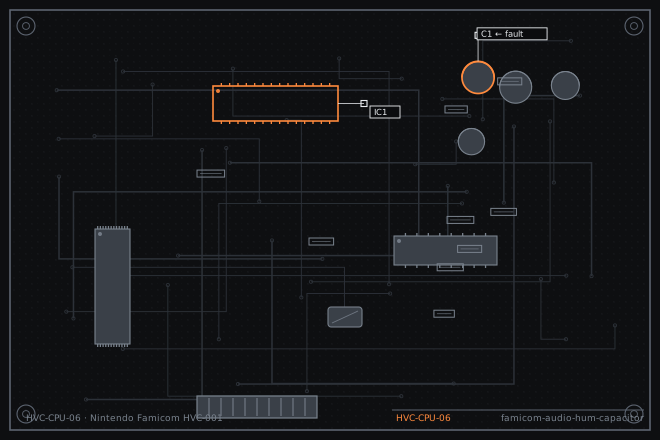
A multimeter will tell you the 5 V rail is fine even when the audio says otherwise. Ripple at 100 or 120 Hz is invisible to a DC reading and very audible through a speaker. This dossier shows how to measure the ripple that matters and which capacitors on an HVC-001 actually cause it.
Hum, buzz or whistle
Hum and buzz are different faults and they sound different. A low 50 or 60 Hz hum with faint harmonics comes from the mains through the filter capacitors. A higher buzz around 100 to 120 Hz is ripple from the rectifier. A whistle or whine that changes with the picture content is usually RF coupling, not a capacitor at all.
Play a game with a quiet soundtrack, turn the volume up and listen before opening the console. Write down the pitch. It is the single most useful diagnostic you can carry to the bench.
Measuring ripple properly
A DC reading of 5.00 V tells you nothing about ripple. Put the meter on AC volts with the 5 V rail loaded and measure from the 7805 output to ground. An HVC-001 in good condition reads under 10 mV AC. Anything above 30 mV AC is audible in the audio path on most TVs.
If the meter does not have a low AC range, use the scope. Set the probe to 10x, AC couple, 20 mV per division and 5 ms per division. You are looking for a sawtooth at twice mains frequency sitting on the DC level.
- Power up with a cartridge fitted and the game paused on a quiet screen.
- Measure the 5 V rail in DC mode and record the value. It will probably read 5.0 V, which is why this fault gets missed.
- Switch to AC volts and measure the same point. Above 30 mV AC confirms a failing filter capacitor.
- Check the large electrolytic near the 7805 first, then the smaller ones on the audio amp section. Look for a domed top, a bulged base, or brown residue on the board beneath the can.
- Touch a fingertip to each suspect can while listening. A capacitor whose ESR has risen will make the hum change pitch or volume when warmed by your hand.
Recapping the rail, not the whole board
Replace the filter capacitors on the 5 V rail and the audio amp decoupling capacitors. You do not need to recap the whole board to fix a hum; that is a much larger job with a real risk of lifting pads on a forty-year-old single-sided board.
Match the capacitance and meet or exceed the voltage rating. A 1000 µF 6.3 V part should be replaced with 1000 µF 10 V or 16 V, never with 6.3 V again. Use 105 °C parts rather than 85 °C; the inside of a closed Famicom shell runs hot in summer and the temperature rating is what determines how long the fix lasts.
- Note the orientation of each capacitor before removing it. The stripe marks the negative lead.
- Desolder one capacitor at a time and fit the replacement immediately. On a single-sided board it is easy to lose track of which pad belongs where.
- Use a 330 °C tip and work quickly. More than three seconds on a pad on this board will lift it.
- Fit 105 °C parts throughout. Add a small heatsink to the 7805 while the shell is open.
- Power up and re-measure AC ripple. Target is under 10 mV AC with the console running a game.
Fault tree branches
where this symptom also leadsIf: Recapping removes the hum but the picture still has diagonal bars
The bars are RF coupling from the modulator or a bad ground on the video cable. Check the modulator shield.
Famicom HVC-001 dead on the bench: blown fuse and a tired 7805If: Hum is present only with a cartridge inserted
Suspect the cartridge slot ground rather than the rail capacitors.
If: The audio is silent rather than humming
This is a different fault. Check the amplifier stage and the RF modulator audio input.